 Ondofinance
Ondofinance Token Types for a First Product Choice
Ondofinance connects different token types to different holder rights, so a first product choice starts with the claim attached to each token. OUSG represents fund interests, while USDY is a yield-bearing note. Ondo Stocks supplies securities exposure, and private-market notes have event-linked payouts. Each category has its own eligibility rules and route for turning a holding into a payment.
A first session can focus on identifying the product and its issuer before starting onboarding or committing funds. The token’s name, reference asset and permitted use need to describe the same holding. Governance tokens and lending receipts require separate interpretations.
Token rights behind similar wallet balances
The legal claim explains whether a token represents a fund interest, securities exposure, an unsecured payment obligation or voting power. Blockchain compatibility describes how that claim moves or interacts with applications.
A wallet can display these holdings with similar balance fields. Their rights remain different. Asset backing can support a token’s economic exposure without giving its holder direct ownership of the underlying security. A lending receipt represents a claim on a lending position. A governance token supplies voting power over protocol decisions. Reading a token’s legal type alongside its backing explains what its balance actually represents. The classification also identifies which issuer or protocol controls the relevant redemption, repayment or governance process.
OUSG fund interests and USDY notes
OUSG and USDY both provide Treasury-related exposure, but their legal structures and access requirements differ. The type of claim determines which terms apply.
OUSG limited partnership interests
OUSG represents limited partnership interests in a fund that invests in Treasury-focused and money market products. Its portfolio also uses bank deposits and USDC for liquidity. Holding OUSG provides exposure through the fund’s investments, with daily yield accrual. The fund structure brings fund expenses and partnership tax reporting into the first product decision. These features remain relevant even when minting or redemption uses a stablecoin transaction. The portfolio can allocate across funds from different asset managers.
USDY issuance and token form
USDY is a tokenized note whose terms can differ by issuance date. USDY moved under the Ondo Stocks umbrella on December 15, 2025. Ondo Global Markets (BVI) Limited now issues USDY; earlier notes came from Ondo USDY LLC. Depending on issuance, backing may include short-term US Treasuries, iShares Short Treasury Bond ETF shares or bank demand deposits. Accumulating USDY reflects yield through its reference price. Rebasing rUSDY wraps USDY and reflects yield through its token balance. Some protocols, exchanges and custodians may not support rebasing tokens. These forms change how income appears without turning the holding into an OUSG fund interest.
Single securities and portfolio baskets
Ondo Stocks gives economic exposure to individual securities, while Ondo Intelligent Portfolios combine weighted baskets within single tokens. Both differ from holding OUSG partnership interests.
Individual stock and ETF exposure
Ondo stock tokens track the economics of publicly traded stocks and exchange-traded funds, or ETFs. Their total-return design includes dividend reinvestment after applicable withholding tax. Corresponding securities and cash in transit back these tokens. The token issuer is Ondo Global Markets (BVI) Limited. A stock token therefore connects the holder to the issuer’s token terms and the referenced security’s performance. It does not put that holder directly on the underlying company’s shareholder register.
Managed baskets within one token
An Ondo Intelligent Portfolio holds a weighted basket of Ondo tokenized securities, with cash in transit where applicable. A model provider sets target allocations, and Ondo implements the strategy and manages rebalancing. The portfolio token reflects constituent price movements and reinvested income after applicable withholding taxes. Its holder gains basket exposure without holding each constituent separately. The portfolio itself is not an ETF or a fund interest, even when its constituents include tokenized ETFs. Its allocation strategy is therefore part of the product choice.
Private-market notes and event-linked exits
An Ondo Private Markets Note ties a future payout to the realized common-share value of a specified private company. Ondo Private Markets Notes are unsecured debt obligations of PM Issuer Co (BVI) Limited. The reference company does not issue the note. Its name identifies the economic reference, while the note issuer owes the contractual payment. No company shares collateralize that obligation.
One note references one common share, and the notes pay no interest or dividends. Their disclosed term runs for 10 years from initial issuance. Contractual redemption events include an IPO, acquisition or other sale of a majority of the reference company’s shares, winddown or term expiry. Event-specific terms determine valuation. For an IPO, the terms set the note price six months after the IPO. Before a qualifying event, holders may transfer or trade notes with other eligible holders. Secondary-market trading and contractual redemption therefore provide different exit possibilities.
A private-note balance and a conditional payout
In this hypothetical example, a reader sees a wallet balance of 142 Ondo Private Markets Notes. Assume the reader held those notes at the liquidity-event record time and the qualifying event fixed a price of 27.42 units of the settlement currency that the Token Terms specify.
Reading the note’s Token Terms identifies an issuer obligation that references company shares. The wallet balance counts those notes, without conveying direct ownership of the shares. The settlement currency and event-fixed price supply the other inputs needed to interpret the payment claim.
Multiplying 142 by 27.42 gives 3,893.64 units of that currency before tax withholding and settlement fees. The gross calculation is concrete, but it is not evidence that the holder has received that amount. Deductions determine the eventual net payment.
This calculation gives the gross amount of an event-linked issuer claim. It does not value a redeemable Treasury fund position or calculate recurring interest. A different record-time holding or event-fixed price would change the gross claim proportionally.
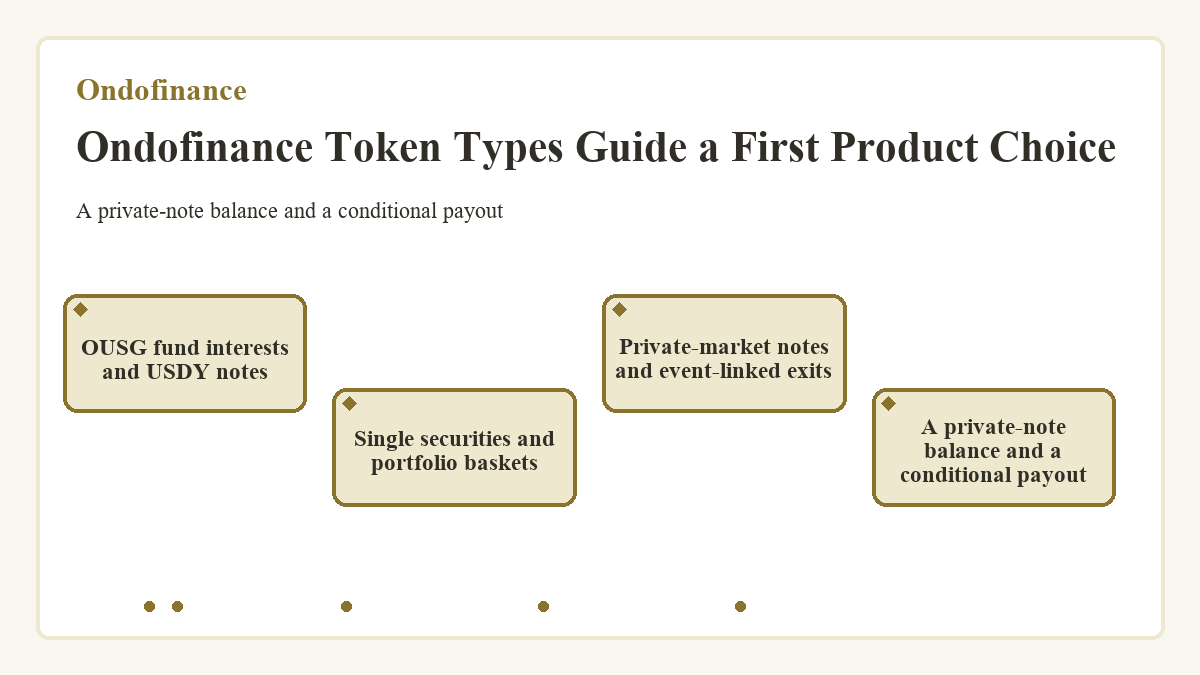
Ondofinance Token Types Guide a First Product Choice
- OUSG fund interests and USDY notes
- Single securities and portfolio baskets
- Private-market notes and event-linked exits
- A private-note balance and a conditional payout
The record-time holder must satisfy the applicable eligibility rules, prove wallet control, complete identity checks and accept the Token Terms. The claim window lasts one year from the liquidity event. The reader can stop after identifying the conditional gross claim, before submitting identity documents or a claim agreement.
ONDO voting power and Flux lending receipts
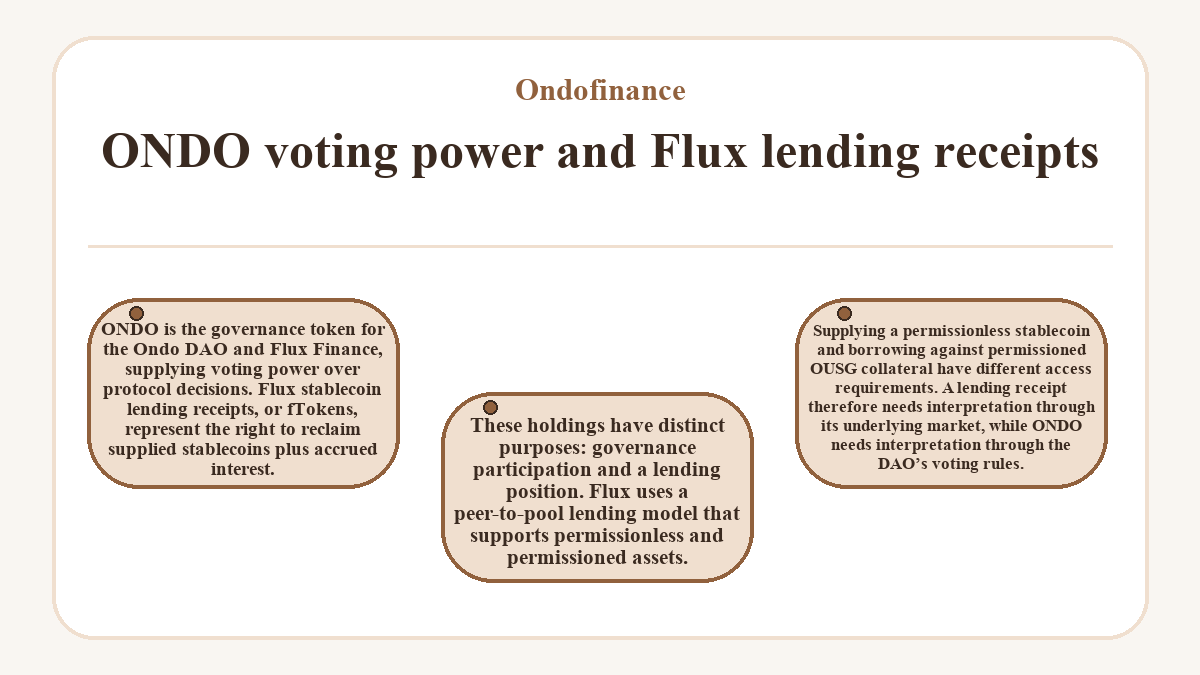
ONDO is the governance token for the Ondo DAO and Flux Finance, supplying voting power over protocol decisions. Flux stablecoin lending receipts, or fTokens, represent the right to reclaim supplied stablecoins plus accrued interest. These holdings have distinct purposes: governance participation and a lending position. Flux uses a peer-to-pool lending model that supports permissionless and permissioned assets. Supplying a permissionless stablecoin and borrowing against permissioned OUSG collateral have different access requirements. A lending receipt therefore needs interpretation through its underlying market, while ONDO needs interpretation through the DAO’s voting rules.
Which token can you access through the issuer?
Issuer access follows the chosen product’s eligibility rules and onboarding requirements. A secondary-market holding or an account login does not establish permission to mint or redeem directly.
OUSG investor qualifications
OUSG requires both accredited investor and qualified purchaser status, along with applicable jurisdictional eligibility. Meeting one designation alone is insufficient. Its $5,000 minimum applies to instant minting and instant redemption transactions. That transaction threshold does not replace either investor qualification.
Stocks, portfolios and USDY access
Ondo Stocks onboarding accepts institutional participants and individuals in supported jurisdictions. U.S. persons and people placing buy orders from within the United States face prohibitions. Other jurisdictional restrictions apply, including professional or qualified investor requirements in some locations. Intelligent Portfolios follows Ondo Stocks eligibility and onboarding rules. USDY also requires qualifying non-U.S. status; its current web-app purchases follow Ondo Stocks terms. No product’s transferable token overrides these requirements.
Private-note holding and claims
Private-market notes are available only to qualifying non-U.S. persons outside the United States, subject to blocked-jurisdiction and sanctions restrictions. Holding a note does not by itself qualify its owner for a redemption payout. The issuer’s claim process also requires identity verification, non-U.S. re-certification, sanctions screening and a claim agreement. This distinction affects the initial choice because obtaining the token and successfully claiming a later payment require different conditions.
Ondo Stocks application stages before a purchase
Ondo Stocks onboarding follows four stages: application initiation, identity or business verification, signing required agreements and account provisioning. Persona handles know-your-customer (KYC) and know-your-business (KYB) verification. Required agreements vary by product. Ondo reviews linked wallet addresses during account provisioning, after verification and signing. A review notice communicates the KYC/KYB application status. Completing a verification submission alone does not establish approval of the account or its wallets.
The application collects identity and residence details, tax information, wallet addresses and information about sources of funds. These requirements attach to the person or entity that seeks issuer access. Account creation and verification concern platform access; acquiring an investment holding requires a separate purchase. Reading product terms before entering onboarding preserves a stopping point before personal-document submission.
Subscriptions, trading sessions and liquidity events
OUSG instant stablecoin minting and redemption operate around the clock within applicable limits and liquidity availability. Its USD route uses business-day processing. A transaction minimum identifies the smallest instant request, while available capacity determines whether a larger request can proceed. The same product can therefore have several liquidity conditions without changing its legal type.
Ondo Stocks generally offers trading across the working week, with short session pauses and other exceptions. Only selected assets support Off-Hours trading during conventional market closures. Ondo Intelligent Portfolio minting and redemption generally run from 9:30 a.m. to 3:45 p.m. ET during regular U.S. market sessions. Those operations pause when any constituent is closed for trading. Portfolio tokens can trade on secondary markets 24/7. Private-market notes use event-linked contractual claims, even when secondary markets support trading before an event. An available market quote and an available issuer redemption describe different ways to exit a holding.
Network support and product compatibility
Network support identifies where a token or tool operates, without changing the underlying investment claim. Ondo Stocks supports Ethereum, BNB Chain and Solana, while bridge routes cover a separately specified chain set. The Ondo Token Bridge uses LayerZero’s burn-and-mint architecture for supported USDY and stock tokens. A chain listing alone does not establish a supported bridge route or acceptance as collateral. Protocol compatibility also follows the selected asset’s permissions, particularly when OUSG secures borrowing.
Fund expenses and quoted transaction costs
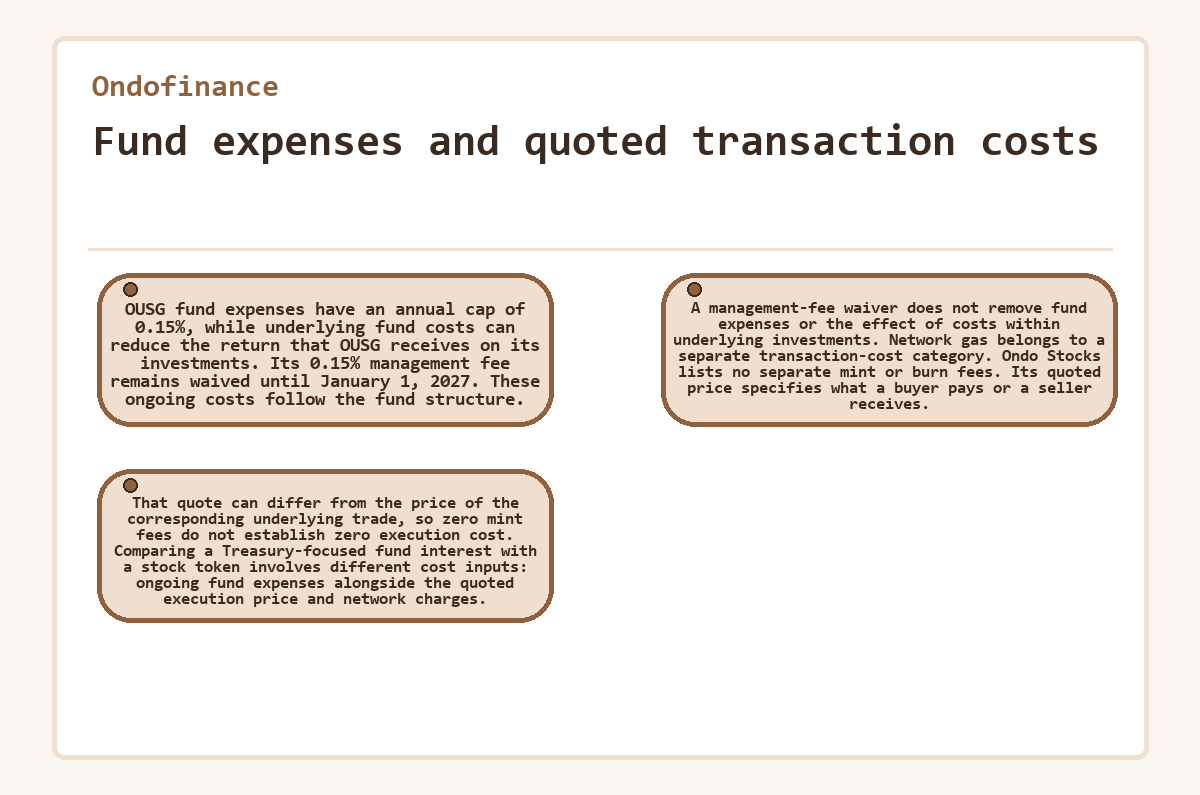
OUSG fund expenses have an annual cap of 0.15%, while underlying fund costs can reduce the return that OUSG receives on its investments. Its 0.15% management fee remains waived until January 1, 2027. These ongoing costs follow the fund structure. A management-fee waiver does not remove fund expenses or the effect of costs within underlying investments. Network gas belongs to a separate transaction-cost category.
Ondo Stocks lists no separate mint or burn fees. Its quoted price specifies what a buyer pays or a seller receives. That quote can differ from the price of the corresponding underlying trade, so zero mint fees do not establish zero execution cost. Comparing a Treasury-focused fund interest with a stock token involves different cost inputs: ongoing fund expenses alongside the quoted execution price and network charges.
Ondofinance questions worth asking
How recent must proof of address be for a first Ondo Stocks application?
Ondo Stocks requires proof of address dated within the last 90 days. Individuals also provide government identification, while entities provide formation documents and an entity tax self-certification form. The required documents support identity or business verification. Application review can produce additional requests, so an earlier submission does not establish that the documentation is complete.
Are Ondo Private Markets Notes ERC-20 tokens?
Ondo Private Markets Notes use the ERC-20 standard on Ethereum Mainnet under the disclosed product terms. The token itself is the note, with no separate paper certificate behind it. ERC-20 describes the technical format, while the Token Terms define the unsecured payment obligation and redemption conditions. A shared token standard does not establish shared investment rights.
Is a whole-token purchase required to begin with Ondo Stocks?
Ondo Stocks permits purchases of fractional tokens. A smaller token quantity still represents economic exposure under the same token structure and does not relax eligibility or onboarding requirements for direct platform access. Fractional token ownership also does not create direct shareholder ownership of the referenced company.
Why might an OUSG instant redemption be unavailable despite meeting its minimum?
OUSG instant redemption depends on remaining capacity and available USDC, as well as its $5,000 minimum. The published limits allow $50,000,000 globally and $25,000,000 per investor within 24 hours. Both limits reset every 24 hours. The smaller remaining allowance constrains the request, and availability of USDC that Circle supports can impose a further limit.
How quickly can a first Ondo Stocks application receive a review?
Ondo Stocks application review can take a few moments to a few days, with substantially longer timelines during high demand. Completing the identity-verification submission does not establish account approval. Additional document requests and required agreements can still affect onboarding completion, and linked wallet addresses also require approval.
Does the Ondo Token Bridge deduct a fee from the tokens transferred?
The Ondo Token Bridge does not deduct a fee from the transferred USDY or Ondo Stocks token amount. Transaction gas and cross-chain gas use the source chain’s native token. The destination receives the same token quantity after the supported transfer completes. The order summary shows the cross-chain fee separately.
What evidence does an OUSG applicant provide for investor qualification?
An OUSG applicant provides evidence for the selected accredited investor criterion and self-attests to the applicable qualified purchaser criterion. Eligibility requires satisfying both designations, with at least one qualifying criterion under each. The permitted criteria differ across individuals and entities. Funding a transaction does not substitute for meeting those qualification requirements.
Which terms govern a private-market note when general descriptions differ?
The applicable offering documents, Token Terms and Risk Factors govern an Ondo Private Markets Note when general descriptions conflict. Future notes may carry different terms from existing notes. The holder’s payment rights therefore follow the particular issuance, including its valuation rules, settlement currency and claim conditions. A company name alone does not establish those terms.