 Ondofinance
 Asset Backing and Token Exposure
Ondofinance creates tokenized Treasury and securities products whose backing and legal structure shape their income, market exposure and redemption rights. USDY provides yield-bearing dollar exposure, OUSG offers qualified-access Treasury fund interests and Ondo Stocks brings stock and ETF exposure onto blockchains. Backed tokens move onchain while financial institutions hold the related underlying assets. Eligibility and redemption conditions vary across products, so blockchain transferability does not give every holder identical access. Curated portfolios combine securities exposure within one token; private-market notes use a different, unsecured structure. Nexus and Ondo Network add minting, redemption and execution infrastructure to this product range.
Bottom line: A fully backed stock token still carries market risk, while direct redemption depends on eligibility and the available trading session.
Treasury tokens, securities tokens and infrastructure
USDY, OUSG and Ondo Stocks connect different investments to blockchain tokens, with each component serving a distinct financial purpose. USDY is a tokenized note that accrues dollar-denominated yield. OUSG represents limited partnership interests in a fund with Treasury-focused investments. Ondo Stocks provides economic exposure to publicly traded securities, including stocks and exchange-traded funds, or ETFs. These products give token holders different claims, even when their tokens appear in similar wallet interfaces.
Nexus supplies minting and redemption technology to issuers of tokenized Treasuries and stablecoins. Each Ondo Intelligent Portfolio packages a basket of tokenized investments into a single token. The financial products determine the exposure; the infrastructure handles particular operations around them.
Ondo Stocks backing and economic exposure
Ondo Stocks links a transferable token to offchain securities holdings, so its investment exposure comes from assets held through financial institutions. Ondo Stocks tokens are backed by their corresponding securities together with cash in transit. The issuer maintains those holdings through US-registered broker-dealers or US-chartered national trust companies. Blockchain transfers move the token that represents the exposure, while the underlying securities remain within that custody arrangement.
Stock tokens track total return. Their economics include changes in the underlying security and reinvested dividends, after applicable withholding tax. A token can therefore represent exposure to more than one underlying share over time. Its unit price need not remain identical to the exchange price of one share, even when the backing remains complete.
Cash in transit includes money moving through the securities investment and settlement process. That cash forms part of the backing arrangement. The token’s exposure still follows the corresponding security, with its market price movements.
Economic exposure also has a legal boundary: holding a token gives the holder the instrument’s contractual rights. It does not place the underlying shares directly into that holder’s brokerage account.
Minting, redemption and secondary-market liquidity
Ondo Stocks connects eligible token holders to traditional securities liquidity through minting and redemption, alongside trading on third-party markets. Direct access accepts qualifying non-US institutions and individuals located outside the US in supported jurisdictions. Onboarding includes know-your-customer identity checks or know-your-business checks, any required agreements and approval of linked wallets. These prerequisites apply before direct purchases and redemptions.
Direct buying creates tokens, while redemption delivers stablecoins representing the underlying assets’ cash value when that route is available. A direct mint or redemption completes through one atomic blockchain transaction.
Secondary trading changes the entry route. Eligible users can acquire tokens through supported exchanges, wallets and decentralized finance, or DeFi, applications. These markets trade existing tokens, while primary minting and redemption connect the token supply with underlying securities liquidity. A secondary-market acquisition does not automatically satisfy the issuer’s onboarding requirements. The venue’s trading conditions and the issuer’s direct redemption conditions remain separate.
Trading sessions and blockchain availability
Ondo Stocks generally offers 24/5 minting and redemption, with selected assets also available during off-hours sessions. That distinction explains why a blockchain can remain active while a particular asset’s direct trading route pauses. Special underlying-market closures, scheduled system downtime and extraordinary events can affect availability. Corporate actions and platform risk limits can also interrupt supported sessions.
Ethereum, BNB Chain and Solana support Ondo Stocks. Ondo Token Bridge separately supports transfers of selected stock tokens among Ethereum, BNB Chain, HyperEVM and Robinhood Chain. The bridge uses LayerZero V2 and its Omnichain Fungible Token standard for native token burning and minting. USDY has its own supported bridge paths. Configured outbound and inbound rate limits apply to each bridge pathway; blockchain transactions that exceed available capacity revert. Third-party trading can operate outside the issuer’s sessions, subject to the venue’s support and applicable restrictions.
USDY income and issuance terms
USDY combines dollar-denominated yield with a transferable token, but its underlying arrangement depends on the issuance terms that apply to the holding. USDY backing can include short-term US Treasuries, shares of iShares Short Treasury Bond ETF or bank demand deposits, depending on issuance date. The product moved under the Ondo Stocks umbrella on December 15, 2025. Legacy issuance and newer purchases therefore need their own applicable terms.
The accumulating USDY token reflects accrued income through an increasing reference price. A holding can earn yield without requiring its token count to increase. Conversion between USDY and its rebasing form, rUSDY, changes how the holding represents accrued income. Cash management and yield-bearing collateral are documented uses, subject to the receiving application’s support. Access remains limited to qualifying non-US persons, with further jurisdictional restrictions. Transferability does not eliminate those restrictions or make direct redemption available to every recipient.
OUSG fund interests and cash management
OUSG gives eligible investors tokenized interests in a Treasury-focused fund, with access requiring both accredited-investor and qualified-purchaser status plus applicable jurisdictional eligibility. The portfolio includes Treasury and money-market investments; BlackRock’s USD Institutional Digital Liquidity Fund, BUIDL, is among its holdings. USDC and bank deposits support liquidity. That structure differs from holding an individual Treasury bill directly, because the token represents a fund interest with its own expenses and terms.
OUSG supports instant USDC minting and redemption on a 24/7 basis, subject to the product’s transaction limits and operating conditions. Instant minting and redemption each have a $5,000 transaction minimum. Remaining global and individual capacity constrain both operations; USDC availability can additionally limit instant redemptions. Dollar-based access follows a separate daily route. Cash management, eligible collateral use and bilateral settlement are documented applications. Ethereum, Polygon, Solana and XRP Ledger are supported networks. A supported chain does not, by itself, establish that every wallet or lending application accepts the token.
Curated portfolios and private-company notes
Each Ondo Intelligent Portfolio combines tokenized stocks and ETFs into a single token whose investment mix follows allocations set by a model provider. Ondo implements those allocations and manages the portfolio onchain, including rebalancing. Each portfolio token gives economic exposure to a weighted basket. Owning a portfolio token does not provide direct ownership of its constituent stocks or make the portfolio itself an exchange-listed ETF.
Ondo Private Markets Notes are unsecured debt obligations of their issuer. Their payout ties to the per-share value realized for a specified private company’s common shares under the note terms. The reference company does not issue the note, and its shares do not collateralize the obligation. A qualifying liquidity event, such as an acquisition or public listing, governs the one-time payout. Notes pay no ongoing interest or dividends. Eligible holders can trade notes on secondary markets or transfer them onchain before that event. The documented notes have a 10-year term from initial issuance and expire if no earlier liquidity event occurs.
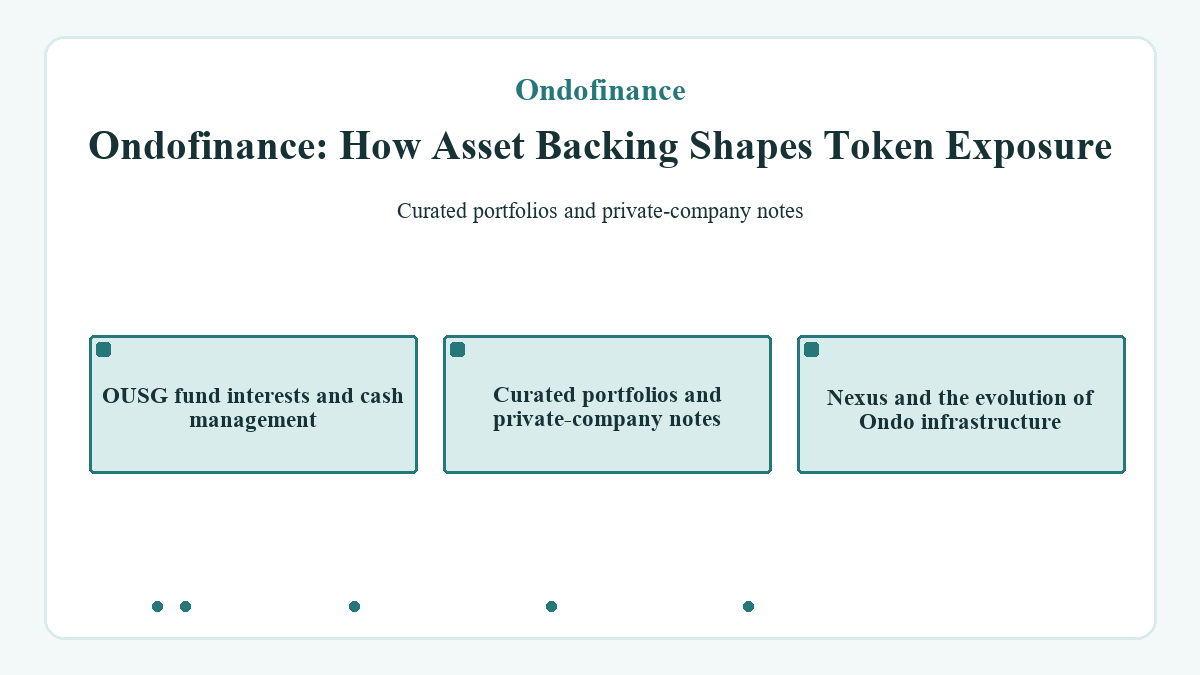
Ondofinance: How Asset Backing Shapes Token Exposure
- OUSG fund interests and cash management
- Curated portfolios and private-company notes
- Nexus and the evolution of Ondo infrastructure
Private-market access is limited to qualifying non-US persons outside the US and other blocked jurisdictions. Sanctioned or otherwise prohibited persons are ineligible. Only holders at the qualifying event’s record time can claim a redemption payout, and they must complete the issuer’s claim process within one year of that event. The issuer’s claim process includes identity checks, proof of wallet control, renewed non-US certification, sanctions screening and a claim agreement. Portfolio tokens follow Ondo Stocks eligibility rules, including non-US restrictions; direct issuer minting or redemption also requires onboarding.
Nexus and the evolution of Ondo infrastructure
Nexus enables tokenized Treasury and stablecoin issuers to offer instant minting and redemption within their supported product integrations. The asset that backs a token remains the responsibility of the relevant issuer and product structure. Nexus technology does not make different Treasury tokens equivalent or give every integrating issuer an identical service schedule.
Ondo Network’s July 27, 2026 introduction described a live execution layer with the perpetual futures platform Ondo Perps as its first application. Its launch design ran application logic in a single secure hardware enclave. Multiple attestors verified approved code, while asset transfers settled on public blockchains. This continued the earlier Ondo Chain infrastructure project through a different architecture. The launch description treated permissionless attestors and broader onchain state settlement as possible further developments, separate from live asset-transfer settlement.
Private execution concerns application activity inside that architecture. It does not mean that public-blockchain asset transfers become invisible or that every tokenized investment uses the same execution system.
ONDO governance and application integration
ONDO is the governance token for the Ondo DAO and Flux Finance, giving it a different purpose from Treasury or stock exposure. Flux supports stablecoin lending and overcollateralized borrowing against OUSG, with permissions enforced per asset. The DAO uses onchain proposals to govern protocol parameters and smart-contract upgrades. Token holders can delegate voting power. Governance participation belongs to the protocol’s decision-making system; Treasury income and stock performance belong to the separate investment products.
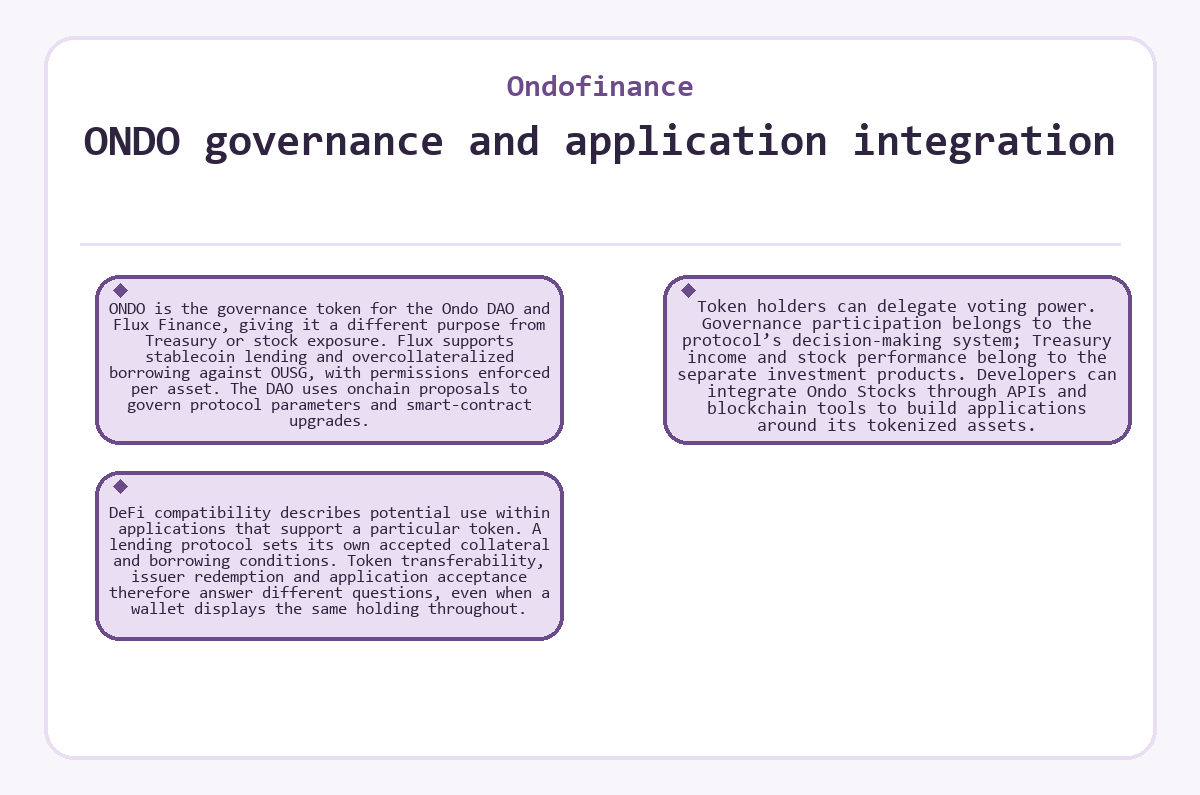
Developers can integrate Ondo Stocks through APIs and blockchain tools to build applications around its tokenized assets. DeFi compatibility describes potential use within applications that support a particular token. A lending protocol sets its own accepted collateral and borrowing conditions. Token transferability, issuer redemption and application acceptance therefore answer different questions, even when a wallet displays the same holding throughout.
Reserve reporting, security interests and market risk
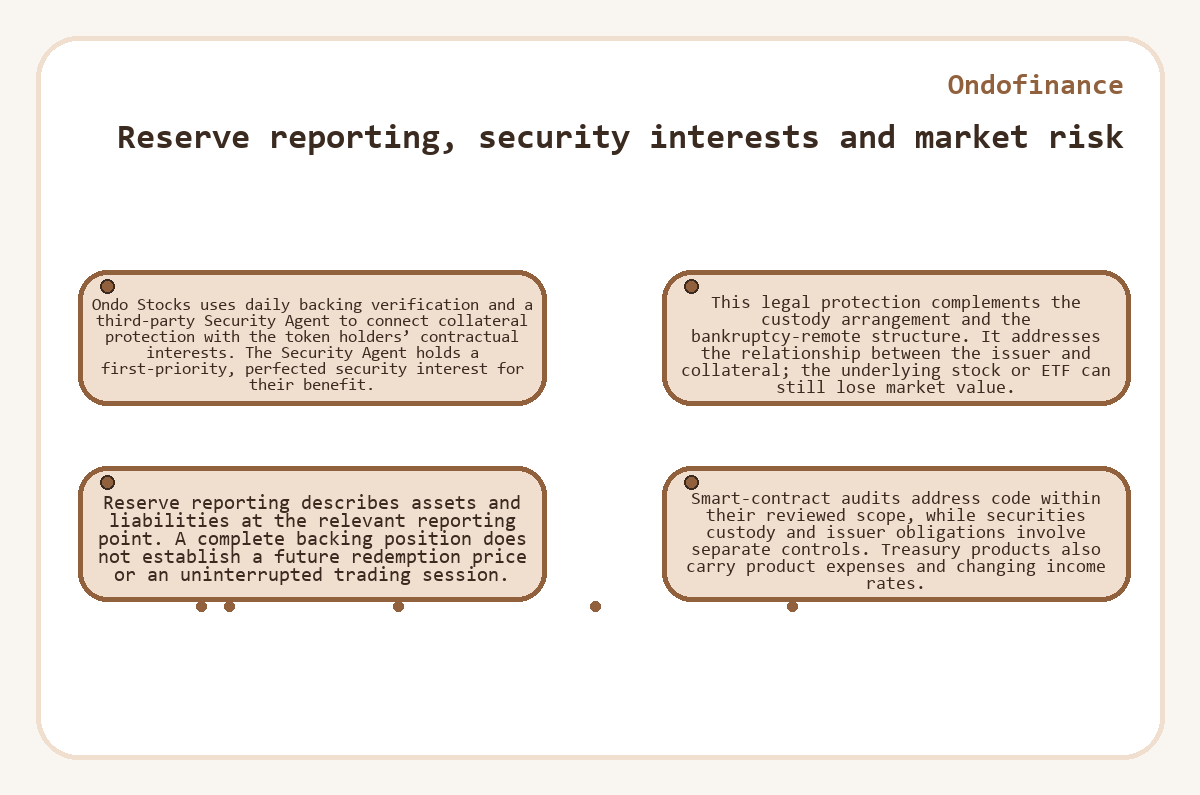
Ondo Stocks uses daily backing verification and a third-party Security Agent to connect collateral protection with the token holders’ contractual interests. The Security Agent holds a first-priority, perfected security interest for their benefit. This legal protection complements the custody arrangement and the bankruptcy-remote structure. It addresses the relationship between the issuer and collateral; the underlying stock or ETF can still lose market value.
Reserve reporting describes assets and liabilities at the relevant reporting point. A complete backing position does not establish a future redemption price or an uninterrupted trading session. Smart-contract audits address code within their reviewed scope, while securities custody and issuer obligations involve separate controls. Treasury products also carry product expenses and changing income rates.
Product selection by exposure and access
A choice between Treasury income and stock performance begins with the investment that the token represents and the access available to its holder. A transferable stock token can support onchain use while direct redemption follows issuer eligibility and market availability. USDY and OUSG can serve cash-management purposes through different legal structures. The product choice changes which income, custody and access conditions accompany the holding.
- For Treasury-related income, distinguish USDY note terms from OUSG fund interests and their separate eligibility requirements.
- For stock or ETF performance, account for the security’s available trading sessions and direct redemption conditions.
- For a curated basket, assess the model-provider allocations that determine the portfolio’s investment exposure.
- For private-company exposure, account for unsecured issuer debt and qualifying-event payout conditions.
- For DeFi collateral, match the exact token and supported network to the receiving application’s acceptance rules.
A conventional brokerage position holds securities exposure within the broker’s account system. Ondo Stocks makes economic exposure transferable as a blockchain token, with a separate issuer and redemption arrangement. The choice changes where the position operates and the contractual rights that accompany it.
Ondofinance FAQs
What does the “on” suffix on Ondo Stocks tickers mean?
The “on” suffix identifies an Ondo tokenized security. Tesla uses the stock ticker TSLA, while its Ondo tokenized counterpart uses TSLAon. The suffix distinguishes the blockchain instrument from the underlying listed security.
How can the same Ondo stock holding look different across blockchain wallets?
Supported Solana and BNB Chain wallets can use display multipliers that adjust the balances and unit prices they show. These displays reflect changes in shares per token, including dividend reinvestment. Wallets without that adjustment show those changes through the token price, as on Ethereum. The presentation difference does not change the onchain token balance or the underlying economic exposure.
Is Ondo Global Markets the same stock platform as Ondo Stocks?
Ondo Stocks is the name of the platform previously known as Ondo Global Markets. Older platform references can therefore describe the same stock-tokenization offering. The name also appears within the legal name of its issuer, Ondo Global Markets (BVI) Limited. A platform rename does not, by itself, identify a different legal issuer or change a token holder’s applicable offering terms.
Does Ondofinance charge an OUSG management fee?
OUSG has a stated management fee of 0.15%, waived until January 1, 2027. Fund expenses are separately capped at 0.15% per year. Expenses within underlying investments can also reduce the returns that OUSG receives. The management-fee waiver therefore does not make every layer of the investment cost-free. Instant minting and redemption currently have a listed fee of 0%.
Why can an rUSDY balance grow while its reference price stays stable?
rUSDY represents accrued yield through rebasing, which increases the token balance while targeting a $1.00 reference price per token. Accumulating USDY expresses income through its reference price instead. This concerns the accounting of the holding, not a promise about every secondary-market trade price. Some applications or custodians do not support rebasing tokens, so compatibility can differ between the two forms.
Are OUSG limited partners issued Schedule K-1 forms?
The OUSG fund issues Schedule K-1 forms to its limited partners because the fund receives partnership treatment for US federal income tax purposes. Each form reports the partner’s share of relevant fund activity, including income, gains, losses and deductions. The reporting concerns the partnership interest represented by OUSG.
Can USDY redemption use a bank wire or a stablecoin?
USDY redemption routes depend on the issuance arrangement and method. The legacy Ondo USDY LLC dollar-wire route requires a non-US bank account. USDY redemption through Ondo Global Markets (BVI) Limited supports USDC under its applicable terms. Those are separate routes with their own eligibility and processing requirements; the non-US bank restriction on the legacy wire method does not describe every stablecoin redemption.
Who sets the USDY yield rate?
Ondo sets the USDY APY monthly under the token’s governing documents. APY means annual percentage yield, so the displayed percentage expresses an annualized rate rather than a promised payout for a particular holding period. The applicable monthly rate can change. Holding an accumulating token also differs from receiving a cash distribution, because accrued income appears in its reference price.