 Ondofinance
Ondofinance USDY reflects accrued yield in each cash management note’s reference price
Ondofinance USDY supports cash management by adding accrued yield to the reference price of each tokenized note. Its accumulating form keeps the token count unchanged as yield accrues. The rebasing form, rUSDY, targets a $1.00 reference price and reflects the same underlying yield through additional tokens.
Reference prices and cash management balances
USDY accrues its underlying yield through holding, without requiring a separate staking transaction. The token form determines where that income appears in a balance record.
Accumulating USDY
Accumulating USDY increases its reference price as yield accrues, while the balance remains unchanged from that accrual alone. Multiplying the token count by that price gives the holding’s reference value. A secondary-market trade uses its execution price, which can differ from the reference value. Ondo sets the annual percentage yield, or APY, monthly under the governing documents. A cash forecast therefore needs the relevant rate and the dates when income enters the price. Under the documented rebasing terms, requesting redemption before the daily price update means the specified USDY or rUSDY tokens do not accrue yield for that day.
Rebasing rUSDY
rUSDY targets a $1.00 reference price and expresses accrual through a growing balance. Its wrapper rebases automatically when USDY’s price updates each business day. Daily yield accrual does not require a visible balance change every calendar day. Ondo lists rUSDY on Ethereum and Mantle. Some protocols, exchanges and custodians do not support rebasing tokens, which can restrict rUSDY’s use for custody or settlement. An application that supports accumulating USDY may still lack support for rUSDY’s changing balances.
Issuance terms after December 15, 2025
USDY moved under the Ondo Stocks umbrella on December 15, 2025, following its earlier issuance through Ondo USDY LLC.
Collateral by issuance date
Different USDY issuance dates can carry different collateral arrangements. The documented possibilities include short-term US Treasuries, iShares Short Treasury Bond ETF shares and bank demand deposits. A holding’s issuance terms determine which arrangement applies. Historical issuance conditions remain relevant to the corresponding notes. USDY retains its yield-bearing note structure within a platform that also offers stock exposure.
Direct purchase eligibility
Current USDY purchases through the web application follow Ondo Stocks terms. Eligible non-US individuals and organizations must complete onboarding before buying directly. Jurisdictional prohibitions and investor-category restrictions also apply. Non-US status alone does not satisfy every local requirement. Onboarding reviews identity and eligibility, and approved wallet addresses connect the account to onchain holdings. After onboarding, USDY’s USDC minting route supports purchases at any time; interest starts when the transaction processes. Under Ondo Stocks terms, a USDC purchase includes a 1:1 swap into USDon, the platform’s native stablecoin, and requires sufficient USDon in the swapper. OUSG has separate qualified-access fund requirements, including accredited-investor and qualified-purchaser status; those tests do not define USDY’s general access.
USDY as collateral and a working balance
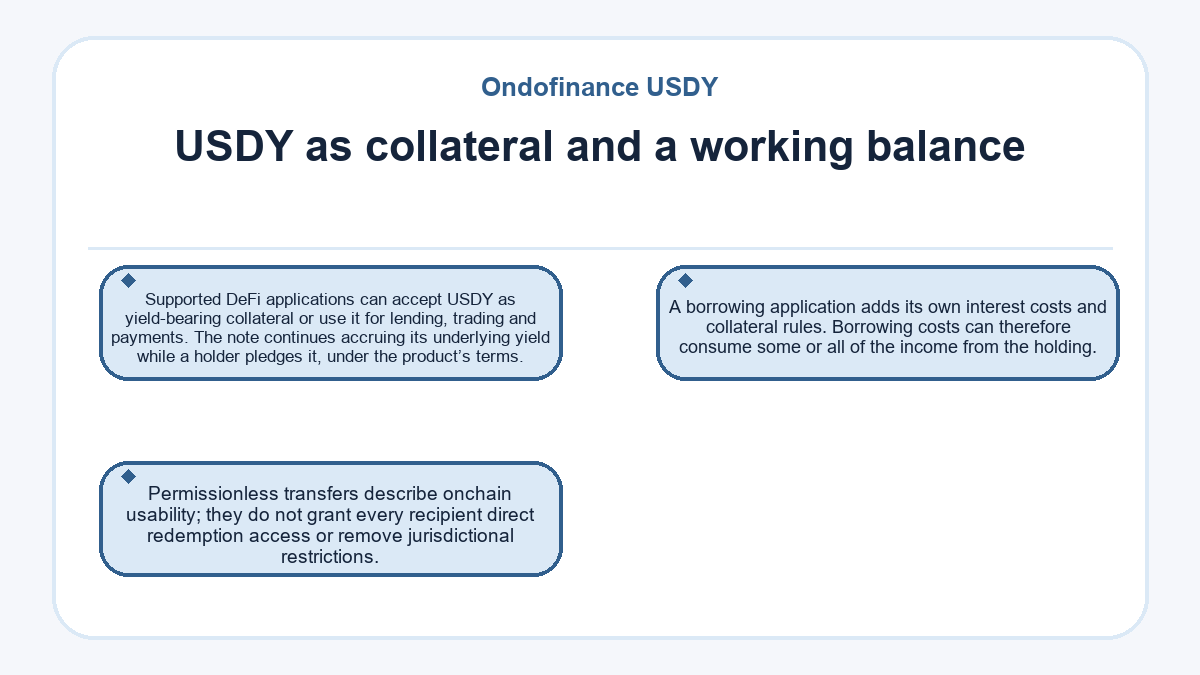
Supported DeFi applications can accept USDY as yield-bearing collateral or use it for lending, trading and payments. The note continues accruing its underlying yield while a holder pledges it, under the product’s terms. A borrowing application adds its own interest costs and collateral rules. Borrowing costs can therefore consume some or all of the income from the holding. Permissionless transfers describe onchain usability; they do not grant every recipient direct redemption access or remove jurisdictional restrictions.
What does converting USDY to rUSDY change?
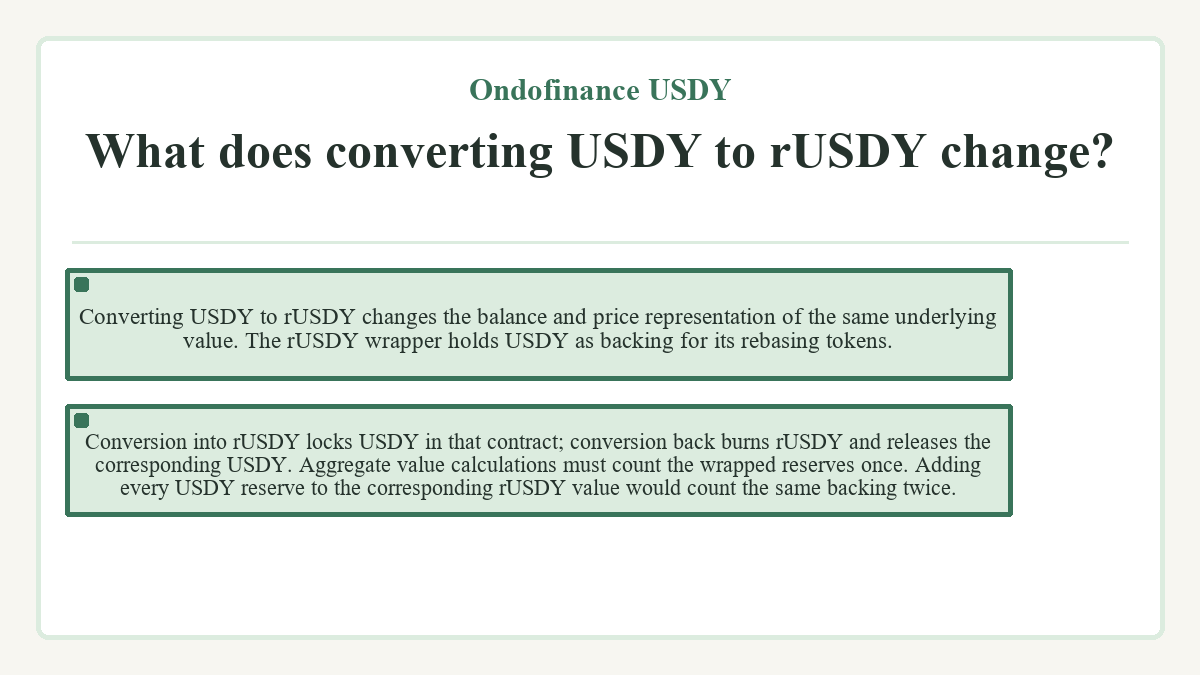
Converting USDY to rUSDY changes the balance and price representation of the same underlying value. The rUSDY wrapper holds USDY as backing for its rebasing tokens. Conversion into rUSDY locks USDY in that contract; conversion back burns rUSDY and releases the corresponding USDY. Aggregate value calculations must count the wrapped reserves once. Adding every USDY reserve to the corresponding rUSDY value would count the same backing twice.
Bridge costs and destination balances
The Ondo Token Bridge uses LayerZero V2 and the Omnichain Fungible Token standard for native USDY transfers. It burns USDY on the source chain and mints it on the destination chain. Decentralized Verification Networks, or DVNs, validate bridging events and post attestations to the destination chain. An executor submits the message payload, and destination minting requires a match with those attestations. The selected pathway determines gas costs and delivery conditions. A source-chain transaction alone does not establish receipt, so destination availability depends on completion of the destination mint.
A USDY transfer with separate gas costs
Consider a hypothetical transfer of 1,234 USDY from Ethereum to Solana, assuming sufficient pathway capacity and an eligible recipient. The bridge charges transaction gas and cross-chain delivery in ETH on Ethereum. Those charges depend on the transaction and the route; this example assumes no fixed gas price or fee amount. Let S represent the source transaction’s gas cost in ETH and C represent the cross-chain charge in ETH. The combined transfer cost is S + C ETH.
After successful message verification and destination execution, the recipient receives 1,234 USDY on Solana. The bridge deducts no transfer fee from that token amount. The USDY count therefore reconciles across the two networks, while the ETH expenditure remains a separate cash management cost. A higher gas charge increases ETH expenditure without reducing the delivered USDY count. A different delivery delay changes when the destination holding becomes available.
The received balance represents tokens, not 1,234 dollars. Its reference value equals 1,234 multiplied by the applicable USDY reference price. That price remains an independent valuation input when comparing token amounts with dollar-denominated payment obligations. Comparing the received token count with the outgoing count confirms the amount delivered. Measuring the ETH fee in dollars requires the ETH conversion rate used for that cost record.
Networks and pathway capacity
USDY bridge routes currently cover Arbitrum, BNB Chain, Ethereum, Mantle, Sei, Solana and Tempo. Native issuance also extends to networks outside that bridge list, including Sui, Aptos, Noble and Stellar. Deployment and bridge availability describe different functions. Both inbound and outbound pathway limits constrain transfers, and capacity refills linearly over time. Transactions above the available capacity revert. The bridge includes an emergency pause feature, so a supported route does not establish continuous availability. The chosen destination address determines which recipient receives the minted USDY.
Why can USDY liquidity differ from its collateral value?
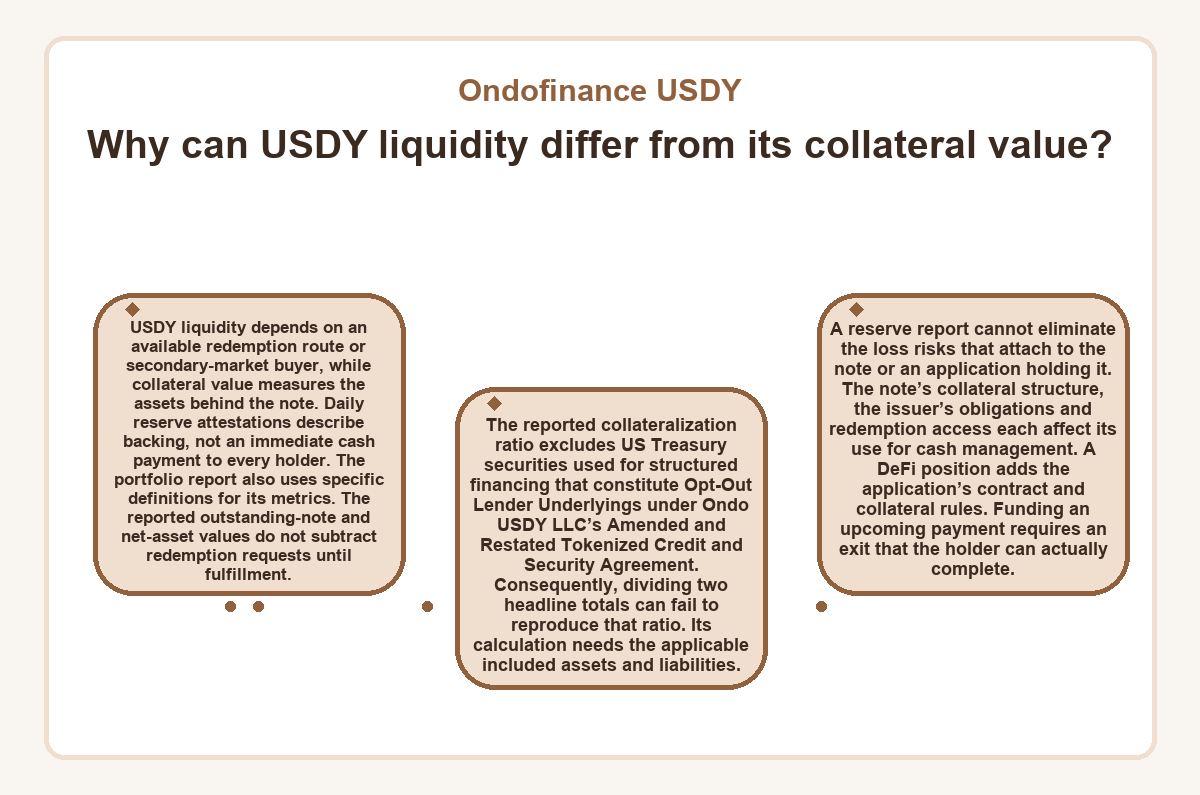
USDY liquidity depends on an available redemption route or secondary-market buyer, while collateral value measures the assets behind the note. Daily reserve attestations describe backing, not an immediate cash payment to every holder. The portfolio report also uses specific definitions for its metrics. The reported outstanding-note and net-asset values do not subtract redemption requests until fulfillment. The reported collateralization ratio excludes US Treasury securities used for structured financing that constitute Opt-Out Lender Underlyings under Ondo USDY LLC’s Amended and Restated Tokenized Credit and Security Agreement. Consequently, dividing two headline totals can fail to reproduce that ratio. Its calculation needs the applicable included assets and liabilities.
A reserve report cannot eliminate the loss risks that attach to the note or an application holding it. The note’s collateral structure, the issuer’s obligations and redemption access each affect its use for cash management. A DeFi position adds the application’s contract and collateral rules. Funding an upcoming payment requires an exit that the holder can actually complete.
Redemption proceeds and cash availability
USDY redemption delivers the settlement asset specified by the applicable note arrangement. Ondo USDY LLC’s bank-wire redemption route requires non-US bank account details before processing. Under the Ondo Stocks framework, Ondo Global Markets (BVI) Limited offers redemption to USDon. Instant conversion to USDC depends on sufficient USDC liquidity in the swapper. This framework does not currently support USD redemptions by bank wire. Daily accrual does not establish a bank payment deadline, and receiving USDC does not mean dollars have reached a bank account.
Secondary-market selling offers another exit on networks where USDY trades peer to peer. A peer-to-peer sale depends on a buyer offering liquidity for the amount being sold. Its settlement arrangement follows the trade’s terms, while issuer redemption follows the note’s access requirements. The settlement asset needed for an upcoming obligation determines which exit fits the cash management task.
Ondofinance USDY - common questions
What is the minimum for support-assisted USDY minting or redemption on Sui?
Support-assisted USDY minting and redemption on Sui have a $5,000 minimum. Both operations require arrangements with the product’s support team. Eligibility restrictions still apply to the holder, so meeting the transaction minimum does not by itself establish access to minting or redemption.
Must a USDY bank-wire deposit meet a specific amount?
USDY Basics describes USD bank-wire deposits from $100,000 after onboarding, subject to the applicable issuance terms. Current web-app purchases follow Ondo Stocks terms, which describe a separate $500,000 minimum for acquiring USDon by bank wire. Onboarded holders can also mint with USDC under the applicable transaction terms.
Can the USDY bridge send tokens to a different recipient?
The Ondo Token Bridge allows a different destination address for a USDY transfer. That address determines who receives the minted tokens on the selected destination network. The recipient choice does not change the source network that charges transaction gas and cross-chain fees, so receipt and fee payment remain separate.
How much USDY can cross a Solana bridge pathway?
USDY bridge pathways between Solana and supported EVM networks have configured limits of 250,000 USDY outbound and 300,000 USDY inbound per pathway over 24 hours. Available capacity at either end can constrain a transfer, and it refills linearly. Ondo can change these settings. These limits count tokens, not dollar value.
Why might a USDY bridge transfer remain pending?
USDY bridge transfers can remain pending while cross-chain delivery completes or network congestion delays execution. Documented delivery times range from 1 to 30 minutes by pathway, with congestion delays reaching 24 hours. LayerZero Scan shows transfer status using the source-chain transaction hash. An unresolved transfer beyond 24 hours warrants support assistance.
Does USDY redemption deliver the Treasury securities that secure the note?
USDY redemption does not entitle holders to receive US Treasury securities. The note supplies economic exposure, with redemption settlement governed by its applicable terms. Collateral backing therefore does not create ownership of the underlying Treasuries or a right to take delivery of them. The settlement asset determines what the holder receives.